
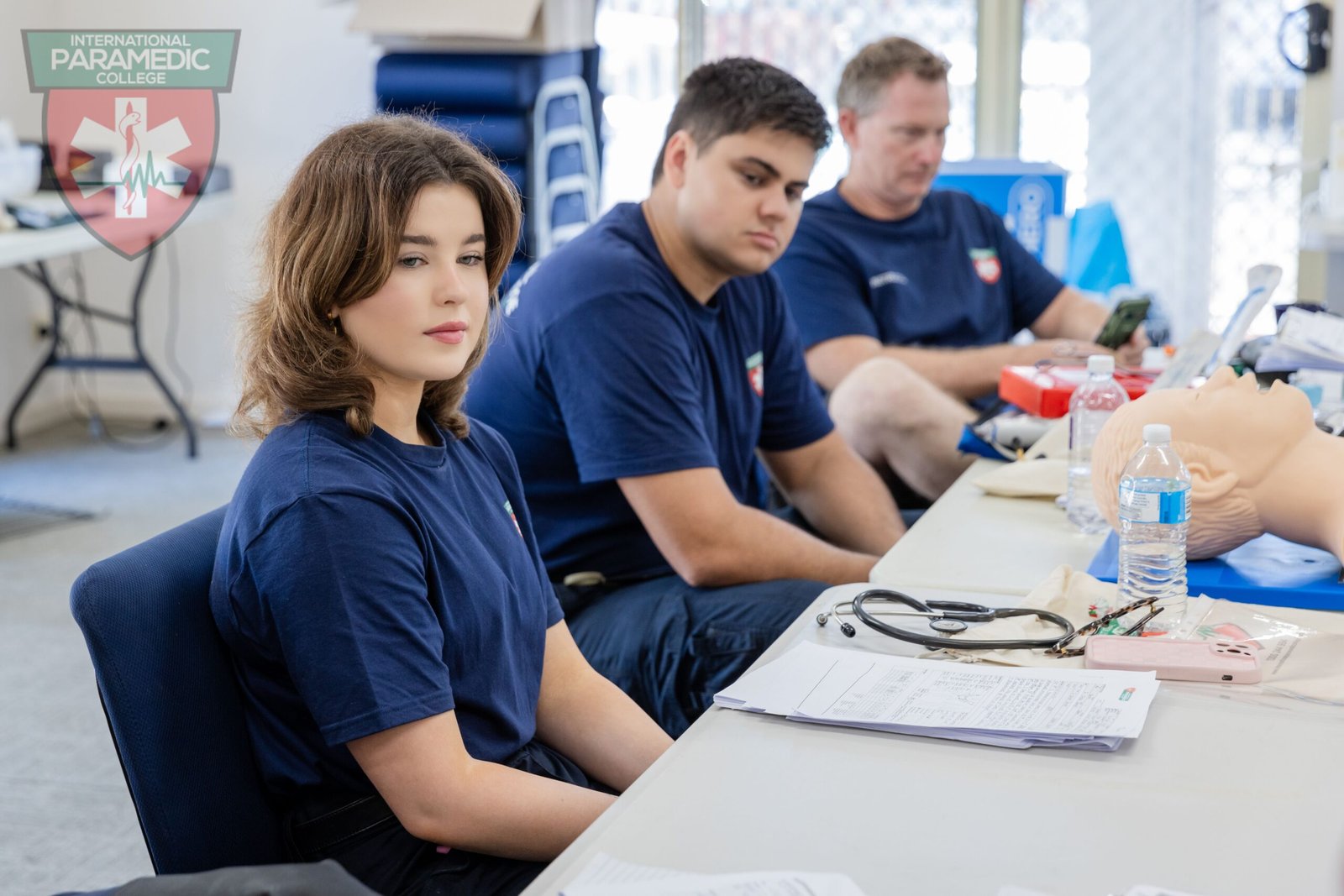


HLT31220 — Certificate III in Basic Health Care:
An Entry Point to Paramedical Education
YOU CAN COMPLETE THIS COURSE 100% ONLINE — ideal as a VET In School’s taster course or university entry for high school students
LOCAL ATTENDANCE NOT REQUIRED — Simply complete a local first aid course where you live before completion of this qualification and submit it to us
Enrol with us today & start your educational journey as a medic or first responder in emergency paramedical prehospital care
Who should study this course?
Embarking on a rewarding paramedic career in Australia requires a strong educational foundation. The HLT31220 — Certificate III in Basic Health Care serves as an excellent starting point for individuals interested in pursuing this path. This qualification provides essential knowledge and skills and serves as a “taster course” for those exploring a career in paramedicine. Let’s explore how the Certificate III integrates into the Australian Vocational system, its role as a stepping stone toward higher qualifications such as the Certificate IV in Health Care, and ultimately, the HLT51020 — Diploma of Emergency Health Care. Discover how this qualification can ignite your journey toward a successful paramedic career. This is a great course for first aid trainers to increase the depth and breath of their knowledge.
Paramedical Education in Australia
Paramedical education in Australia is crucial for training individuals to provide emergency medical care in diverse settings. Paramedics play a vital role in delivering pre-hospital care, working alongside other healthcare professionals to assess, stabilise, and transport patients in critical situations. A comprehensive education equips paramedics with the necessary knowledge, practical skills, and clinical experience to excel in this demanding field.
HLT31220 — Certificate III in Basic Health Care: A Taster Course
The HLT31220 — Certificate III in Basic Health Care can serve as a standalone qualification or as a valuable “taster course” for aspiring paramedics. This qualification provides foundational training, offering individuals an opportunity to explore and assess their interest and suitability for a career in paramedicine. It offers an introduction to the fundamental principles of healthcare delivery, with a focus on basic patient care.
The Certificate III curriculum covers essential topics, including basic anatomy and physiology, infection control, medical terminology, and communication skills. Students learn how to provide basic patient care, assist with medical procedures, and contribute to the overall well-being of patients. This qualification often includes practical placement opportunities, allowing students to gain hands-on experience in healthcare settings.
Course Cost Payment options
Payment plan
The registration and enrolment fee for the interest free payment plan is an initial payment of $295. The $1495.12 course fee is then paid over 8 fortnightly instalments of $186.89 per fortnight. Must be over 18 years of age to use a payment plan.
To pay upfront below you will only pay the $1495.12 course fee. By paying the full amount upfront below, you will save the extra $295 payment plan registration fee.
Note: No refunds apply when using a payment plan. No certificates or statements of attainments will be issued until payment of the full course fees. Payment failures: I understand that if there are insufficient funds in the specified account to cover the Autopay transaction, the cardholder may be subject to an additional admin fee of $45 by International Paramedic College Pty Ltd
Upfront payment
The course fee is $1495.12 for 1 upfront payment. Total payment of $1495.12 — no payment plan registration fee.
How long do I have to finish this course?
The Australian Qualifications Framework (AQF) uses 'volume of learning' to describe how long a typical student will take to develop the required skills and knowledge to be competent at each qualification level. Volume of learning represents all teaching, learning and assessment activities – supervised and unsupervised, structured, and unstructured.
For each of the following courses, you have:
- Certificate II - 6 months to 1 year to complete the course
- Certificate III - 1 to 2 years to complete the course
- Certificate IV - 6 months to 2 years to complete the course
- Diploma - 1 to 2 years to complete the course
Paramedical Pathways
We have a fantastic promotional price on the Diploma of Emergency Health, formerly known as the paramedic diploma.
With us, you can jump straight into the Diploma of Emergency Care to train as a medic or follow a pathway approach as outlined below.
Integration with Higher Qualifications: Pathways to a Diploma of Emergency Health Care
The HLT31220 — Certificate III in Basic Health Care serves as a foundational step towards higher qualifications within the Australian Vocational system. One such qualification is the HLT41120 - Certificate IV in Health Care, which builds upon the knowledge and skills acquired in the Certificate III.
The Certificate IV in Health Care delves deeper into topics such as advanced patient assessment, pharmacology, and clinical interventions. This qualification prepares individuals for more specialised roles within the healthcare system and provides a broader scope of practice.
By completing the Certificate III and progressing to the Certificate IV in Health Care, individuals create a seamless educational pathway that aligns with the paramedical field. This integration allows for credit transfer and the recognition of prior learning and facilitates a smoother transition to higher qualifications, such as the HLT51020 - Diploma of Emergency Health Care.
How to Become a Paramedic: Navigating the Educational Pathway
To become a qualified paramedic in Australia, individuals can follow a clear educational pathway that encompasses several key steps:
Step 1: Obtain the HLT31220 — Certificate III in Basic Health Care as a starting point to gain essential knowledge and skills.
Step 2: Progress to the HLT41120 — Certificate IV in Health Care to further develop your expertise in patient assessment and clinical interventions.
Step 3: Gain practical experience through clinical placements and internships, which are often integrated into the Cert IV paramedical programs.
Step 4: Consider obtaining additional certifications and training in specialised areas such as advanced life support, trauma care, or paediatric paramedicine.
Step 5: Complete the HLT51020 — Diploma of Emergency Health Care to further enhance your skills and
Step 6 Continue onto University confident that this is the career for you and prepared with advanced standing experience and confidence
Our paramedic pathway, and it costs you no more time
With us, you can jump straight into the Diploma of Emergency Care to train as a medic or
Try before you commit to one training provider, who may not be what you thought they were when you sign up for a Diploma with large upfront costs that you never get back.
Use the pathway as a taster program to see if returning to learning is for you.
Get qualifications as you go along to work or transfer to other health related courses with common core units, e.g. Nursing or Aged Care
Do a course written by us and we are proud of it. An Australian Intensive Care Paramedic with significant and some would say “old school approach to paramedic education and real-world patient management skills. We are not a sales team, we are clinicians.
We use an Australian Paramedic Textbook as the core learning material. All assessment tasks are Paramedic-based, not generic health industry content.
Use this as a VET in school's taster program. Our Cert II and Cert III can be completed 100% online. Cert IV and the Diploma require 3 day practical workshops and a pre-practical online primer session.
We are the real deal. A paramedical college run by paramedics with significant clinical and educational experience.
Our educators for these programs are leaders in this field nationally
This qualification reflects the role of first medical response workers or volunteers who provide initial care to patients. These people provide basic first aid and emergency responses in the pre-hospital or out-of-hospital environment.
No occupational licensing, certification or specific legislative requirements apply to this qualification at the time of publication.
Employment Pathways
Completion of this course does not guarantee employment. Please check any specific job or licensing requirements with your employer or regulator.
Completion of this qualification may improve your employment prospects in roles requiring first response medical skills. While we do not guarantee employment, this course provides nationally recognised skills that may support work in emergency response, pre-hospital care, or workplace first aid settings, depending on employer requirements.
This qualification or the Diploma of Emergency Health Care does not meet the Australian Health Practitioner Regulation Agency (AHPRA) standards for national registration as a paramedic within state-based ambulance services. To achieve this, you must enrol in a university and complete a three-year degree, a requirement consistent across all Australian providers. If you are looking to go into a state-based ambulance service straight away, then the university pathway would probably be best for you. Any advanced standing will be dependent on individual university requirements, and students should seek advice from any relevant tertiary institution before enrolment to determine the entry requirements for any specific field of study they may want to pursue in the future.
Units in your clinical pathway, 11 Units in total
Your course units will be delivered in the following sequence. We have developed this pathway to provide you with the best clinical outcome for your studies with us and this simplifies the pathway to higher qualifications.
All our units are written by us and have a paramedic/prehospital care focus
Note: Unit marked with* has a prerequisite HLTAID011 Provide First Aid.
HLTAAP001 Recognise healthy body systems
BSBMED301 Interpret and apply medical terminology appropriately
HLTINF006 Apply basic principles and practices of infection prevention and control
HLTWHS002 Follow safe work practices for direct client care
CHCDIV001 Work with diverse people
HLTWHS006 Manage personal stressors in the work environment
CHCLEG001 Work legally and ethically
Simply do your first aid course locally and/or provide us with a copy of your current first aid certificate for a credit transfer.
PUAEME008 Provide Pain Management (Green Whistle training)*
CHCDIV002 Promote Aboriginal and/or Torres Strait Islander cultural safety
HLTOUT010 Communicate in complex situations to support health
* We added the Unit PUAEME008 Provide Pain Management as an elective here, as it provides better real-world workplace outcomes for students and teaches you about the methods and checks we use in administering drugs in pre-hospital care. A green whistle training device will be required to complete the unit.
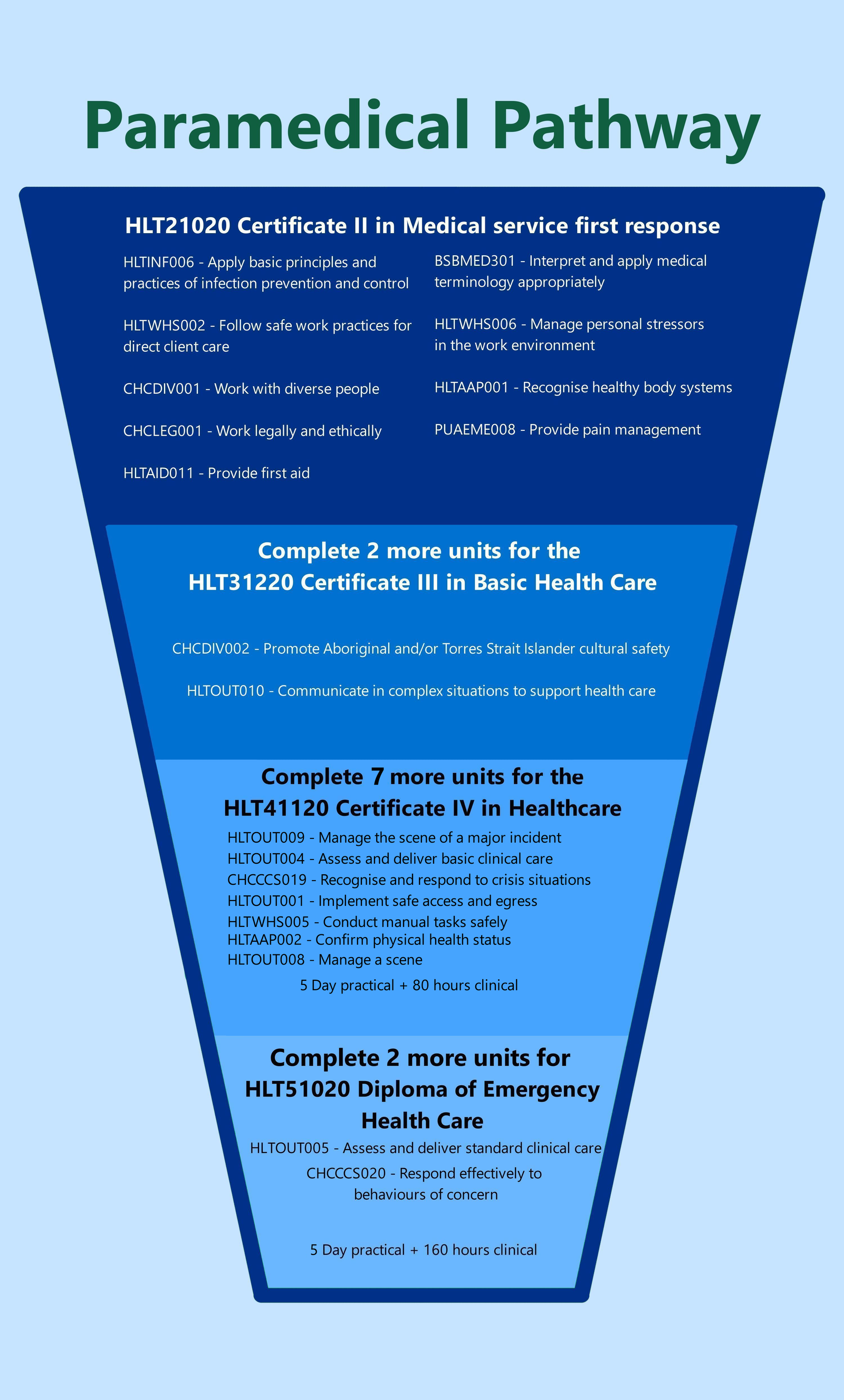
These units are common units in the paramedical and general health care sector training and education courses.
All our units are written by us and have a paramedic/prehospital care focus
Paramedical EMT First Responder Courses and Learning Pathway to Becoming a Paramedic
HLT21020 Certificate II in Medical Service First Response
HLT31220 Certificate III in Basic Health Care
HLT31120 Certificate III in Non-Emergency Patient Transport (NEPT)
HLT41120 Certificate IV in Health Care (First responder EMT Medic)
HLT51020 Diploma of Emergency Health Care (Paramedical Training)
Health & Administration Units
HLT37315 Certificate III in Health Administration
HLT47315 Certificate IV in Health Administration
HLT37215 Certificate III in Pathology Collection
Nursing & Community Services Units
CHC43115 Certificate IV in Disability
CHC43015 Certificate IV in Ageing Support
HLT51020 Diploma of Nursing
Pre Hospital Care and Health Care Jobs and Career Choices
Career Opportunities in the Health and Community Sector
The health and community services sector is one of Australia’s fastest growing industries, with evolving roles driven by advances in patient care and service delivery. The nationally recognised units and qualifications we offer can support a wide range of job roles across this dynamic sector.
We encourage you to explore our training options and consider how they align with your career goals. You may wish to develop a career plan to help identify the skills and qualifications you need.
To find out more about how our courses can support your pathway into the health and community services workforce, or for personalised assistance, please contact us.
For assistance, Contact us

Study Mode
100% Online learning
Must have a current first aid certificate prior to completion

Course Fees
$1495.12 Upfront
Payment plan of 8 payments available + registration fee, see details here
100% online completion available with a current first aid certificate
Local attendance not required to complete this course

RTO
45284
Important course information - Please read
Important course information — Please read
International Paramedic College (RTO 45284) is a registered training organisation delivering nationally recognised training.
-
Completion of a course does not guarantee employment
-
Students are encouraged to confirm any licensing, registration, or job requirements with prospective employers or industry regulators before enrolling
-
The HLT51020 – Diploma of Emergency Health Care does not lead to registration as a paramedic with AHPRA under the National Law
Online Enrolment Terms and Conditions
This summary outlines your rights and obligations when enrolling with International Paramedic College (IPC). Full details are available on our Student Information Page.
1. Eligibility for Enrolment (Including Visa Requirements)
Enrolment at International Paramedic College (IPC) is open to students who meet the entry requirements for their chosen course and are legally entitled to study in Australia.
It is the student’s responsibility to ensure they hold a valid visa that permits study with a Registered Training Organisation (RTO) in Australia.
- IPC does not enrol international students on a student visa (subclass 500), as we are not a CRICOS-registered provider under the ESOS Act.
- Students on other visa types (e.g. working holiday, bridging, partner) must confirm their visa permits study with an Australian RTO.
- Visa documentation must be supplied upon request.
If you enrol without holding a valid visa that permits study, you do so at your own risk. Refunds will not be provided if your visa prevents course completion.
2. Payment, Transfers, and Refunds
All changes to enrolment must be made in writing via email. No changes will be accepted via phone, SMS, or other methods.
Refer to our Payments, Refunds and Cancellation Policy for full terms.
- Fees are non-transferable between individuals.
- Certificates are issued only after full payment is received.
- Manual payments may delay processing or certificate issue.
- Only the original booking contact may request changes for group/organisation bookings.
3. Refunds and Special Consideration
We offer fair and reasonable refund practices in line with the Australian Consumer Law. In exceptional cases (e.g. medical emergencies), a refund or course transfer may be considered upon written request and supporting evidence.
Contact us at training@internationalparamediccollege.com.au
4. Course Entry Requirements and LLN
By enrolling, you confirm that you have reviewed and understand any applicable entry or Language, Literacy and Numeracy (LLN) assessment requirements for your course.
5. Student Support and Reasonable Adjustment
You are required to notify us before enrolment if you have support needs, such as learning difficulties, disabilities, or access limitations.
Read more in our Student Support Policy.
6. RPL and Credit Transfer
You may apply for Recognition of Prior Learning (RPL) or Credit Transfer (CT) by providing appropriate evidence.
Details available at: RPL and CT Policy
7. Complaints and Appeals
If you are dissatisfied with any aspect of our service, you are entitled to submit a formal complaint or appeal.
See our Complaints and Appeals Policy.
8. Assessment and Academic Integrity
All assessments submitted must be your own original work. You confirm compliance with our Plagiarism and Use of AI Policy.
We may use plagiarism and AI-detection tools to validate authenticity.
9. Privacy and Data Collection
Your data is collected in line with the Privacy Act 1988 and the National VET Data Policy. It may be shared with NCVER or government agencies for research, reporting, and regulatory purposes.
10. Unique Student Identifier (USI)
You must provide a valid USI to receive your certificate. If you do not provide one, your results will not appear in the national USI registry.
More info: www.usi.gov.au
11. Certificate Issuance
Certificates or Statements of Attainment will be issued within 30 days of competency if all course components are complete and fees are paid. All certificates are issued electronically with built-in verification tools.
12. Confirmation of Agreement
By enrolling, you confirm the following:
- You meet the physical and academic requirements of the course.
- Your assessment responses are your own original work.
- You authorise IPC to liaise with the USI Office or your employer regarding training records (unless otherwise notified).
- You understand and accept these Terms and Conditions, including all linked policies and fee conditions.
If you need to make any changes to your practical course date for CPR and First Aid-type courses, a rebooking fee will apply if you fail to provide 5 days' notice by email or online. If you are unable to attend for any reason, fees, and charges may be applied as per our Payments, refunds, and cancellation policy available here.
Any request to change your course booking, must be done by email.
Course Fees and Payment Plans
The use of payment plans is covered by the autopay agreement when you sign up for a plan. Payment plans are not available to students under 18 years of age. Certificates or Statements of Attainment will not be issued until course fees are paid in full.
Our refund policy and any terms and conditions are available in the footer of our website.
Locations
Many of our courses are 100% online and self-paced. Our practical components, if applicable to your course, are held several times a week locally at our public venues. Location details and maps are provided on enrolment if practical attendance is required, for your convenience, or course location and venue information can be accessed here.
If you want training in your workplace or on-site, contact us here.
Course Requirements
Access to a computer with the internet, as well as basic computer skills access to technology assets to complete the online/ pre-course studies required for completion of this unit
Basic numeracy and literacy skills are needed to attend this course.
Access to a computer with internet access, as well as basic computer skills access to technology assets to complete the online/ pre-course studies required for completion of this unit
If you have ANY special needs (e.g., language/literacy/numeracy difficulties/ physical disabilities etc) that you think may impact on your ability to complete this training, please let us know before enrolling
Requirements for Completion
You must complete 100% of any training and satisfactorily complete all the competency-based assessment tasks in the units.
Physical Requirements
Practical activities involve training scenarios conducted at floor level and contact with other students/instructors. Please wear suitable clothing.
CPR, as an example, is a rigorous physical activity requiring you to compress the chest of a manikin downwards about a third of the chest depth continuously at 100 to 120 times a minute for a continuous period of 2 minutes. First aid and CPR type courses require you to perform 2 minutes of CPR on an adult manikin on the floor and two minutes of CPR on an infant on a firm surface. If you are doing a childcare type first aid course, you will be required to do an additional 2 minutes of CPR on a child manikin. This requires a level of endurance, strength, and fitness appropriate to this task. If you have current physical injuries, medical problems or limitations, please discuss this with your trainer. You must don’t injure yourself or exacerbate an existing condition in training.
Other units of study may involve driving or moving patients, depending on the particular requirements of the unit. Please contact us before enrolment if you would like to discuss individual units.
The Assessment Process
We use a range of assessment methods to gather evidence of your knowledge and applied skills for this course. The assessment methods may include multiple choice questions, short written answers and practical activities. On enrolment in, you will be provided with access to International Paramedic College’s course learning materials; it is expected that you have read and understood the contents and completed any pre course learning before starting the assessments. Full information about the assessment requirements and course content is available below.
On enrolment, you will be provided with a login to our student portal to access online assessment tasks. We understand that this may not suit everybody. If you have particular requirements, please contact us. It is expected that you have read and understood the learning materials to develop your responses to the assessment tasks, and completed any assessment tasks as per the student instructions and with the learning materials for that module. The use of AI or software to generate answers to assessment takes is covered in our plagiarism and the use of AI policy available on our student information page or in the footer of our website.
Our express delivery option requires you to complete pre-course learning before attendance.
Learner Support
At International Paramedic College, we are committed to supporting each learner to successfully complete their training. We recognise that some learners may require additional educational or wellbeing support, and aim to identify and respond to these needs early and effectively. International Paramedic College is aware of the need to identify the individual support needs of learners and to provide access to educational and wellbeing support services to enable them to meet the requirements of the training product in which they are enrolled. Learner support includes any educational and support services that a learner may need to assist them in their training.
We will provide wellbeing support in the form of services and resources to assist with learners’ physical, mental, and emotional wellbeing. This may be provided through one-on-one support by a designated staff member or through referral to appropriate external services where the individual’s needs are out with our professional abilities and expertise.
We need to identify any particular requirements such as literacy, numeracy, English language or physical capabilities that learners would have to complete each course, and develop strategies to make support available where gaps are identified.
If you’re enrolling for a full qualification, you’ll should have a detailed discussion with a trainer and assessor before starting. This is to ensure you understand the course requirements and can talk through any support needs.
You will be asked at course registration to identify any support need you may need. This will be flagged to your trainer/assessor so they are aware and can provide appropriate support or, where needed, referrals to qualified external professionals.
Reasonable adjustments may be made to your training or assessment to help you succeed, while still meeting competency standards.
Our student management system allows you to flag support needs directly to our staff, trainers, and assessors at any time during your course.
You should contact us to discuss any particular support requirements you may have before enrolment, and to understand the physical requirements of CPR training as an example. Reasonable adjustments may be made to your training or assessment to help you succeed, while still meeting competency standards.
Emergency response training can sometimes be confronting or triggering. Please let us know if you require additional support.
A copy of our student support policy is available here
Reasonable Adjustment – Learning difficulties
Enrolment in this training requires participants to provide details on any learning or physical difficulties which may impact on their training outcomes. This may include any language, literacy, or numeracy issues.
Students may also discuss any special needs with your assessor, who may be able to make any required, reasonable adjustment to the assessments to meet these needs. Please note the requirements under physical activity below.
Reasonable adjustment may include access to paper-based assessments or limited additional time to complete online tasks due to technical difficulties or access issues to online assessment systems. Additional time, fees, or charges may apply for this delivery option.
Please note, to be deemed competent in any unit requiring CPR or first aid you must be physically able to perform the following (these requirements cannot be changed):
Uninterrupted CPR for at least 2 minutes on an adult manikin placed on the floor
Uninterrupted CPR infant manikin placed on a firm surface.
Additionally, childcare first aid students must perform uninterrupted CPR for at least 2 minutes on an adult manikin placed on the floor
Please speak with us before enrolment assessment if you have any concerns.
Students must have reasonable English language skills, as all units are assessed in English and access to a computer and the internet.
If you have particular requirements or well-being needs, please contact us to discuss your situation before enrolment
Read our full Learner Support Policy here
Language Literacy numeracy
Please notify us before enrolment if you have any Language Literacy or Numeracy issue. All assessments are conducted in English.
Language literacy and numeracy (LLN) assessment tool information
An 'ACSF Assessment Task/Tool' or 'LLN Assessment Task/Tool' is a diagnostic assessment tool used to determine an individual's language, literacy, and numeracy (LLN) skill levels.
The tasks typically consist of various reading, writing, maths and oral communication questions designed to be relevant to workplace tasks.
The idea is that the tools will help gauge a person's current LLN skill levels and identify whether they have the required LLN skills to effectively interact with information and complete tasks that would be commonplace in a certain job, and if not, where the areas of required support are.
While IPC is not involved in VET Loans, there are assessment tools and tasks provided that some students may like to use to assess LLN needs Information is available here
Student interviews are conducted before enrolment in our qualifications like the
- HLT21020 Certificate II in Medical service first response
- HLT31220 – Certificate III in Basic Health Care
- HLT41120 Certificate IV in Healthcare
- HLT51020 – Diploma of Emergency Health Care
You can book your pre enrolment interview where any LLN issues can be discussed as well as the course content and details about assessment activities costs payment plans workplacemts etc
Student handbook
In addition, the Student Handbook provides a guide to studying with us
Requirements for Completion
You must complete 100% of the training course and satisfactorily complete all the competency-based assessment tasks. If you feel you may need some support to complete the learning or assessment tasks, either because of a literacy issue, a learning difficulty or a physical disability, please let us know. We may be able to make adjustments to our learning and assessment processes. Information concerning reasonable adjustment and the type of student support services we supply can be found in our Student Handbook.
Entry Requirements — Pre requisites
You will be notified of any prerequisites before enrolment for any particular course on the webpage. While there are no prerequisites for the majority of our courses, you will need to have sufficient English language skills to complete the competency-based and online training.
You will need access to the internet and certain basic computer skills to complete the online learning modules.
A driver's licence will be required for any transport units
The unit PUAEME008 Provide pain management and HLTAID015 Advanced resuscitation both have a current first aid course (HLTAID011) as a prerequisite, and you will require a green whistle training device or old stock of the device to simulate administration of the pain management drug. Full details are available here.
Students must have reasonable English language skills as all units are assessed in English
A current photo ID is required to identify you in video submissions
Units may require you to answer
Short answer questions
Multiple choice questions
Open-ended questions
Complete research projects
Provide a written and/or oral handover of a patient to medical support services
Complete written reports like patient reports and risk assessments in English
Communicate with patients in English
Produce videos of certain assessment tasks
Read and interpret medical materials like protocols procedures pharmacology or clinical practice guidelines in English
Read and interpret learning materials and textbooks in English
Diploma and Cert IV students will be required to complete work placements. You may need to complete any requirements a work placement may require at your expense eg Induction, vaccination, travel, accommodation etc. These will vary according to various workplaces. Students should inquire with potential workplaces about any specific requirements.
Under 18
Participants under the age of 18 are required to provide a consent form completed by their legal guardian when they attend training.
Students under the age of 14 may complete non-accredited training with a parent or guardian present at the time of training and for the duration of the non-accredited course. A consent form is required.
Unique Student Identifier Number (USI)
From 1 January 2015, anyone undertakes nationally recognised training delivered by a Registered Training Organisation will need to have a Unique Student Identifier (USI). If you have not yet applied for a USI, you will have to do so before attending training with us.
Finding your USI Number
If you have undertaken any registered training since 2015, you may already have a USI.
If you don’t have one, applying is easy.
If you require help in obtaining one, please contact the office. If you are unable or choose not to provide a USI, or have an exemption granted under the Student Identifiers Act 2014. Then your training outcome will not be recorded on your USI account and will not be available in future years as part of the authenticated USI transcript service. More information is available about USI numbers on our website here.
Recognition of Prior Learning — Credit transfer
We offer recognition of existing skills and knowledge, please refer to our Student Handbook or website here for more information.
If students have units with the same code number in qualifications they are completing with IPC they can apply for credit transfer. Please send the certificates or Statements of Attainments and transcripts so we can confirm those credit transfers with the issuing RTO.
Student Services Information and Policies
We have a student services webpage that provides information for students here
Our student handbook, refunds, payment plans, terms, and conditions and our policies on are available in the footer of this website. Students can access these at any time. Information for students is provided in the student handbook.
Review the student handbook provided by your IPC, which includes policies, procedures, and support services available to you.
Important Assessment information - Please read
Important Assessment information — Please read
Every effort has been made to ensure the contents of assessment packages, learning materials and College documents are free from errors or omissions. However, you should conduct your own enquiries and seek professional advice where necessary before relying on the facts, statements, or materials contained in this assessment pack. International Paramedic College is not responsible for any injury, loss, or damage resulting from material included in or omitted from this assessment pack resource.
Information in our training and assessment packages is current at the time of publication.
Our courses may have a world-wide audience and emergency laws and regulations vary from state to state and country to country, so this course cannot be definitive on all legal issues for your workplace or location. This information is not legal advice and is for guidance only. When in doubt, always seek legal counsel.
All workers, regardless of their field or profession, operate within a legal and ethical framework. This simply means that we all work within the boundaries defined by applicable laws and ethical standards. This study guide aims to provide the healthcare worker with a sound introduction to the legal aspects of working within an ambulance environment.
As a healthcare worker, you have legal obligations to yourself, your patients, the organisation in which you work and your co-workers. To meet these obligations, it is important to know the laws that relate to your work and ensure you carry out your work role in accordance with those laws.
The Assessment Process – An Introduction
You will have been provided with access to International Paramedic College’s (IPC) course learning materials, and it is expected that you have read and understood the content prior to starting the assessments. You will have been advised of any specific learning materials or resources required for your assessment.
We use a range of assessment methods to gather evidence of your knowledge and applied skills for a unit or qualification.
What is Competency-Based Assessment?
Competency-based assessment is the process of gathering evidence to confirm that participants can perform the required skills and knowledge for the unit or course they are enrolled in. To complete a unit of competency, participants are required to successfully demonstrate their skills and knowledge in all the activities within this assessment. Rather than using a marking scale, competency-based assessment determines competency as either 'competent' or 'not yet competent'.
You are required to successfully demonstrate competence in all the activities in this assessment. If you are unable to answer a question, your answer is deemed not satisfactory. For any of the assessment activities where you are unable to satisfactorily demonstrate competence, your assessor will work with you to identify opportunities for further training if required and arrange re-assessment when you are ready or at the end of the session.
If you are unable to demonstrate your ability in any area of the assessment, you will be re-assessed. Re-assessment may include demonstrating a skill, answering questions, or providing further information. All participants are given two opportunities to be reassessed without further payment required. On occasions where participants are unable to demonstrate competency after two re-assessment attempts, they will be required to re-enrol in the unit(s) or directed back to the learning materials to review before any reassessment.
Effective assessment must follow the principles of assessment
The Australian Government Quality Skills Authority requires training organisations to follow the principles of assessment it has stated as:
Fairness
- The individual learner’s needs are considered in the assessment process.
- Where appropriate, reasonable adjustments are applied by the RTO to take into account the individual learner’s needs.
- The RTO informs the learner about the assessment process and provides the learner with the opportunity to challenge the result of the assessment and be reassessed if necessary.
Flexibility
Assessment is flexible to the individual learner by:
- reflecting the learner’s needs
- assessing competencies held by the learner, no matter how or where they have been acquired
- drawing from a range of assessment methods and using those that are appropriate to the context, the unit of competency and associated assessment requirements, and the individual.
Validity
Any assessment decision of the RTO is justified, based on the evidence of performance of the individual learner.
Validity requires:
- assessment against the unit/s of competency and the associated assessment requirements covers the broad range of skills and knowledge that are essential to competent performance
- assessment of knowledge and skills is integrated with their practical application
- assessment to be based on evidence that demonstrates that a learner could demonstrate these skills and knowledge in other similar situations
- judgement of competence is based on evidence of learner performance that is aligned to the unit/s of competency and associated assessment requirements.
Reliability
Evidence presented for assessment is consistently interpreted, and assessment results are comparable irrespective of the assessor conducting the assessment.
The rules of evidence
Students and assessors are reminded that the rules of evidence in assessment are that the assessment evidence provided by the student for the assessment tasks have
Validity
The assessor is assured that the learner has the skills, knowledge and attributes as described in the module or unit of competency and associated assessment requirements.
Sufficiency
The assessor is assured that the quality, quantity, and relevance of the assessment evidence enables a judgement to be made of a learner’s competency.
Authenticity
The assessor is assured that the evidence presented for assessment is the learner’s own work.
Currency
The assessor is assured that the assessment evidence demonstrates current competency. This requires the assessment evidence to be from the present or the very recent past.
Authenticity of work
By submission of your assessment tasks, students are declaring that the work submitted for the unit is their own original work. You are confirming that you have completed all requirements for this assessment in accordance with the guidelines and scenarios provided in the learning resources for the unit, and have articulated your responses in your own words. Students should be aware that AI detection software is employed by the college, and by submitting work to us, you are affirming that you have fully adhered to the college’s policy on Plagiarism and the appropriate use of AI programs. You understand that the work you submit will be reviewed to determine your competency in the unit of study.
Students are requested to base their answers on the specific situations outlined in your learning resources for that unit. Please incorporate that knowledge as you address questions in the units.
We have a plagiarism and AI policy available on the student Information page of our website.
Assessment Appeals Procedure
For information on how to appeal an assessment decision, refer to the Complaints and Appeals Policy included in the Student Handbook available on the student Information page of our website.
Questions & Answers
Depending on the question style, where appropriate, students are required to answer questions in their own words to demonstrate understanding. Questions can also be completed orally. You can answer the questions verbally with an assessor or another support person, such as a supervisor or mentor. When undertaking an oral assessment, you are required to answer the questions in your own words, and your assessor or support person is required to document your answers.
Learner Support
Learner support includes any educational and support services that a learner may need to assist them in their training.
We need to identify any particular requirements such as literacy, numeracy, English language or physical capabilities that learners would need to complete each course, and develop strategies to make support available where gaps are identified.
You will be asked at course registration to identify any support need you may need. This will be flagged to your trainer/assessor so they are aware and can provide appropriate support.
You should contact us to discuss any particular support requirements you may have before enrolment and to understand the physical requirements of CPR training as an example.
Plagiarism and the use of Artificial Intelligence Programs (AI)
International Paramedic College (IPC) is committed to fostering a positive learning environment and nurturing strong relationships with our students. We aim for clarity regarding tasks and behavioural expectations to mitigate anxiety and prevent academic misconduct.
Authentic assessments are designed for students to undertake tasks that reflect real-world challenges, thereby demonstrating the practical application of essential knowledge and skills. Such tasks mirror those encountered in actual workplace settings, allowing for the use of diverse reference materials, expert consultations, and supervisory guidance (Sridharan & Mustard, 2015, p.4).
Plagiarism is taking and using someone else’s thoughts, writings or inventions and representing them as your own. Plagiarism is a serious act and may result in a participant’s exclusion from a module unit or a course. When you have any doubts about including the work of other authors in your assessments, please consult with your trainer or IPC administration team.
The following list outlines some of the actions for which a participant can be accused of plagiarism:
- Presenting any work by another individual as one’s own unintentionally
- Handing in assessments markedly similar to or copied from another student
- Presenting the work of another individual or group as their own work.
- Handing in assessments without the adequate acknowledgement or referencing of sources used, including assessments taken totally or in part from the internet or AI programs.
- Using artificial intelligence (AI) generated responses in assessment tasks without explicit instruction to do so.
As part of IPC’s policies, students may be asked to affirm that they will not utilise AI platforms, tools, or homework help websites for completing assessment tasks, acknowledging that such actions contravene IPC’s plagiarism policy. Furthermore, students are prohibited from sharing assessment answers or any intellectual property with others or on any AI platform, tool, or homework help website, as this constitutes a breach of our policy. By adhering to these guidelines, IPC students maintain the integrity of their educational journey, ensuring that their learning experience is both authentic and reflective of IPC’s commitment to excellence in paramedic education.
Where the use of AI programs or plagiarism is detected in student submissions, the following process will be followed by IPC:
- Portal access will be suspended until a systematic review of the student’s current and past submissions can be conducted.
- If a review of submissions finds that an AI program has been used or plagiarism has occurred, IPC will initiate a cost recovery process for the administrative time required for the review.
- The fee for review will be $100 per hour (with a minimum charge of 1 hour).
- The fee must be paid in full before any resubmission will be accepted.
- This charge is separate from course re-enrolment fees and only applies where additional compliance and academic integrity processes are required.
- Portal access will be restored only after the review and payment of any fees and charges.
- Students should allow 14 days for the review process to be conducted. The rules of evidence will be applied in the review process.
Procedures and Guidance for Students
Students should be guided by the learning materials and course textbooks when seeking to answer assessment tasks. Students short answer assessment tasks should be in “their own words” except when specifically asked for example to “list 5 causes of …….” As an example.
Students' answers to questions should be of sufficient depth to show an understanding of the question. Submissions may be returned to students asking for more depth and clarity in response to a question or questions
Reviews of student’s assessments submissions will be made and if the use of AI type programs or references that appear outside the learning materials and textbooks, we may ask that students resubmit work to us or reference their sources appropriately.
If an assessor has concerns that this plagiarism and AI policy has been breached, then the submitted assessment will be referred to the training manager for review.
The student may be asked to review their submission or provide evidence that the submission matches the rules of evidence, that the submission is the students own work. That may require re submission of the assessment with appropriate references or adjustments.
For online courses where a video is submitted as evidence, a photo ID may be requested from the assessor to confirm that it is the student performing the assessment tasks.
Students may be asked to follow a particular pathway progression through programs to enhance practical training and deliver optimal learning outcomes by building knowledge sequentially
Reviews of students’ assessments submissions will be made and if the use of AI type programs or references that appear outside the learning materials and textbooks, we may ask that students resubmit work to us or reference their sources.
Access to our Plagiarism and the use of AI Policy is available here
Individual Workplaces
We are aware that the answers, information and projects completed will differ from one student to another depending on their workplace, Scope of practice, clinical practice guidelines and/or experience. We encourage you, wherever possible, to apply the requirements of your assessments to your workplace. We will use generic examples of Clinical Practice Guidelines as an industry basis for applying treatment modalities in accordance with current industry standards.
We are not assessing your ability against anyone else, and we do not compare your work to that of other students to determine if you are competent or not. We only assess your evidence to demonstrate the skills and knowledge to meet the requirements of the unit.
Where appropriate, your assessor will work with you and your supervisor, if employed, at the beginning of the unit to identify appropriate activities and/or projects that you can use when completing the assessment activities. If your workplace does not have the required documents, resources, and/or equipment to undertake the training and assessment activities in a unit, we will provide access to generic examples of these for you.
You will find that if you are required to provide work samples, the activity asks you to use your workplaces template, forms, checklists, and policies. If your workplace does not have these, we will provide examples that you can work with.
Work Samples
Where they are required, work samples are documents which have been created in the workplace or in the same style and manner which is appropriate to the workplace. With all work samples, you must maintain confidentially of all parties, including the employer, clients, and any other person.
If you are submitting real workplace documents, you must gain permission from all relevant personnel (this must be written) and submit the approval with the documents.
Evidence can take many forms and be gathered from many sources
Indirect evidence or using other parties to collect supplemental evidence if required must be done in accordance with the required standards. This fact sheet provides information about clause 1.8 of the Standards for RTOs 2015. For further information on assessment and clause 1.8 requirements, please refer to the Users’ Guide to the Standards for Registered Training Organisations 2015.
Alternative Assessment and Adjustments to Assessment Activities
If you are unable to complete a particular activity or have a suggestion of a relevant workplace activity that would meet the requirements of a unit, we encourage you to discuss this with your Assessor or the IPC team.
Foundation Skills
Foundation Skills are embedded in the assessment tasks, this means that the language, literacy, numeracy, and employment skills you are required to demonstrate during your participation are assessed at the same time as the other required skills and knowledge for the unit.
Competency Completion
You must successfully complete all assessment activities to be deemed competent.
Results
1. Individual assessment tasks will be marked as:
Satisfactory (S) Not yet Satisfactory (NYS)
2. On the completion of all assessment tasks a final result will be given as:
Competent (C) Not yet competent (NYC)
You will be given the results to knowledge-based assessment activities automatically online or at the beginning of your face to face/practical session and you will be given the opportunity to re-sit any tasks you did not satisfactorily complete at the end of the session.
Your assessor will give you feedback as you complete the practical assessment activities and, again, if you are not given a satisfactory outcome on the first attempt you will have the opportunity to re-sit these tasks at the end of the session or contact the administration team to make alternative arrangements.
Reasonable Adjustment — Learning difficulties
Enrolment in our training requires participants to provide details on any learning or physical difficulties which may impact on their training outcomes. This may include any language, literacy, or numeracy issues.
Students may also discuss any special needs with your assessor, who may be able to make any required, reasonable adjustment to the assessments to meet these needs. Please note the requirements under physical activity below.
Reasonable adjustment may include access to paper-based assessments due to technical or access issues to online assessment systems in a particular workplace. Additional time, fees, or charges may apply for this standard delivery option.
Please note, to be deemed competent in any unit requiring CPR or first aid you must be physically able to perform the following (these requirements cannot be changed):
Uninterrupted CPR for at least 2 minutes on an adult manikin placed on the floor
Uninterrupted CPR infant manikin placed on a firm surface.
Additionally, childcare first aid students must perform uninterrupted CPR for at least 2 minutes on an adult manikin placed on the floor
Please speak with us before enrolment assessment if you have any concerns.
Students must have reasonable English language skills, as all units are assessed in English and access to a computer and the internet.
If you have particular requirements or well-being needs, please contact us to discuss your situation before enrolment
Language Literacy Numeracy
Please notify us before enrolment if you have any Language Literacy or Numeracy issue. All assessments are conducted in English.
Language literacy and numeracy (LLN) assessment tool information
An 'ACSF Assessment Task/Tool' or 'LLN Assessment Task/Tool' is a diagnostic assessment tool used to determine an individual's language, literacy, and numeracy (LLN) skill levels.
The tasks typically consist of various reading, writing, maths and oral communication questions designed to be relevant to workplace tasks.
The idea is that the tools will help gauge a person's current LLN skill levels and identify whether they have the required LLN skills to effectively interact with information and complete tasks that would be commonplace in a certain job, and if not, where the areas of required support are.
While IPC is not involved in VET Loans, there are assessment tools and tasks provided that some students may like to use to assess LLN needs Information is available here
Student interviews are available before enrolment in our qualifications like the
- HLT21020 Certificate II in Medical service first response
- HLT31220 – Certificate III in Basic Health Care
- HLT41120 Certificate IV in Healthcare
- HLT51020 – Diploma of Emergency Health Care
You can book your pre-enrolment interview where any LLN issues can be discussed as well as the course content and details about assessment activities costs, payment plans, workplacemts etc
Entry Requirements — Pre requisites Paramedical type courses and units
You will need to have sufficient English language skills and digital literacy expectations to complete the competency-based and online training components of your course or unit.
You will need access to the internet and certain basic computer skills to complete the online learning modules.
A driver's licence would be required for any transport units if included in your course, eg HLTOUT007 Transport non-emergency patients under operational conditions and HLTOUT006 Transport emergency patients.
The unit PUAEME008 Provide pain management and HLTAID015 Advanced resuscitation both have a current first aid course (HLTAID011) as a prerequisite,
The HLT21020 Certificate II in Medical Service First Response and HLT31220 — Certificate III in Basic Health Care will both require the completion of HLTAID011 Provide first aid which student will need to complete with a local provider and submit to IPC for Credit Transfer
You will require a green whistle training device or old stock of the device to simulate administration of the pain management drug. Full details are available here.
Students must have reasonable English language skills as all units are assessed in English
A current photo ID is required to identify you in video submissions
Units may require you to answer
Short answer questions
Multiple choice questions
Open-ended questions
Complete research projects
Provide a written and/or oral handover of a patient to medical support services
Complete written reports like patient reports and risk assessments in English
Communicate with patients in English
Produce videos of certain assessment tasks
Read and interpret medical materials like protocols procedures pharmacology or clinical practice guidelines in English
Read and interpret learning materials and textbooks in English
Physical requirements for practical training and work placement for The HLT51020 — Diploma of Emergency Health Care or HLT41120 — Certificate IV in Health Care. Will require you to be involved in the uncontrolled nature of emergency work in a prehospital environment.
Work safely with sharps. e.g. needles, syringes iv sets etc
Manual handling, lifting and moving patients, loading and unloading a stretcher into an ambulance
Deal with simulated and actual workplace emergency responses, often in uncontrolled field environments. Violent aggressive or uncooperative patients and members of the public.
Work placement may involve exposure to a range of emergencies that may be confronting.
Recognition of Prior Learning (RPL)
Recognition of Prior Learning (RPL) is the acknowledgement of competencies obtained through formal training, work experience and life experience. If you feel you are entitled to recognition, please discuss with your assessor, who will explain the process in detail.
We offer recognition of existing skills and knowledge, please refer to our Student Handbook or website here for more information.
If students have units with the same code number in qualifications, they are completing with IPC they can apply for credit transfer. Please send the certificates or Statements of Attainments and transcripts so we can confirm those credit transfers with the issuing RTO.
Assessment Appeals
If you are unhappy with the result of an assessment, talk to your assessor first to see if can resolve the issue. However, if you are still not happy, we have an Assessment Appeals Process, this can be accessed in our Student Handbook via a link in the footer of our website.
Further Information
In addition, the Student Handbook provides a guide to studying with us
Further information relevant to our assessment processes can be found in the Student Handbook, or you can contact the office or your trainer for a hard copy. Topics include:
- Recognition of Prior Learning (RPL)
- Credit Transfer (CT)
- Student Support
- Student Rights and Responsibility
- Reasonable adjustment
- Complaints and Assessment Appeals Procedure and Forms
- Issuing Certificates and Statements of Attainment
- Assessment Outcomes
- Reasonable Adjustment
- Submission of Assessments
- Authenticity of work
- Foundation Skills
- COVID-19 Adaptive measures
You can visit the student information page on our website here
Specific Unit or Course Information
Complete details of the unit or course can be found at online at The Australian Government Department of Skills and Employment website here at https://training.gov.au/.
Unique Student Identifier Number (USI)
From 1 January 2015, anyone undertakes nationally recognised training delivered by a Registered Training Organisation will need to have a Unique Student Identifier (USI). If you have not yet applied for a USI, you will have to do so before attending training with us.
Finding your USI Number
From 1 January 2015 anyone undertaking nationally recognised training delivered by a Registered Training Organisation will need to have a Unique Student Identifier (USI). If you have not yet applied for a USI, you will need to do so prior to attending training with us. To apply or to check if you already have a USI number is a very quick and painless online process at the Australian Government website www.usi.gov.au. Follow the prompts as a student. Click here to apply on-line or check your USI number.
If you require help in obtaining one, please contact the office. If you are unable or choose not to provide an USI, or have an exemption granted under the Student Identifiers Act 2014, then your training outcome will not be recorded on your USI account and will not be available in future years as part of the authenticated USI transcript service.
The USI transcript service is provided by the Australian Government, not by International Paramedic College. They request we provide student information to them annually in January. We do not add that information to their register, they do it. Please read the information they provide on their site titled "When will my training appear".
https://www.usi.gov.au/documents/your-usi-transcript
If you have any further queries, do not hesitate to contact us.
If you have undertaken any registered training since 2015, you may already have a USI.
If you don’t have one, applying is easy.
If you require help in obtaining one, please contact the office. If you are unable or choose not to provide a USI, or have an exemption granted under the Student Identifiers Act 2014. Then your training outcome will not be recorded on your USI account and will not be available in future years as part of the authenticated USI transcript service. More information is available about USI numbers on our website here.
Submission of answers
Complete the online assessment activities and upload any written documents outlining the skills and knowledge asked for. They will be marked, and any feedback provided to you by the system or at the practical session from your assessor.
If students you do not get a question(s) correct, you will have the opportunity to discuss the topic in class with your trainer and re-answer the question(s) at the end of class. Your trainer will give you another answer sheet if it is required or may submit your corrections online via our SMS. This can be done by the trainer asking you verbally for any corrections.
If you have any learning or physical needs that make reading or writing the answers to the questions difficult, please contact our office prior to class, and we will discuss any reasonable adjustments we can make to facilitate you completing this task.
If students would like to ask any questions or be provided with additional feedback, our student management system allows you to summit and enquiry
Student Information
Important course information about your enrolment with International Paramedic College and our policies is always available on the student information page of our website here.
https://firstaid.sysnolodge.com.au/student-information/
We have a student services webpage that provides information for students here
Our student handbook, refunds, payment plans, terms, and conditions and our policies on are available in the footer of this website. Students can access these at any time. Information for students is provided in the student handbook or our FAQ page.
Review the student handbook provided by your IPC, which includes policies, procedures, and support services available to you.
Our marketing materials are regularly reviewed and updated to ensure accuracy, especially when there are changes to course content, delivery methods, or regulatory requirements.
Student should note that International Paramedic College dos not offer VET fee help on its courses or units.
Pre Hospital Care and Health Care Jobs and Career Choices
Career Opportunities in the Health and Community Sector
The health and community services sector is one of Australia’s fastest growing industries, with evolving roles driven by advances in patient care and service delivery. The nationally recognised units and qualifications we offer can support a wide range of job roles across this dynamic sector.
We encourage you to explore our training options and consider how they align with your career goals. You may wish to develop a career plan to help identify the skills and qualifications you need.
To find out more about how our courses can support your pathway into the health and community services workforce, or for personalised assistance, please contact us.